An AI contact center service uses artificial intelligence to help customer support teams handle conversations more efficiently across channels like voice, chat, email, and messaging. Instead of replacing people, modern AI is most valuable when it augments agents and streamlines customer journeys: answering common questions instantly, routing requests to the right team, summarizing interactions, and surfacing knowledge in real time.
The result is a contact center that feels faster and more consistent for customers, while being more manageable and measurable for operations leaders. An omnichannel cloud contact center software approach can reduce repetitive work, shorten resolution cycles, and improve the overall experience without compromising quality—showcasing intelligent customer engagement via AI contact centers.
To plan effectively, it’s important to review AI contact center services pricing. Costs can vary based on the range of AI services deployed—such as virtual agents, real-time agent assist, analytics, and workflow automation—as well as interaction volume and number of users. Understanding pricing upfront ensures organizations can scale AI capabilities efficiently, optimize operational performance, and deliver measurable improvements in both customer satisfaction and agent productivity.
What is an AI contact center service?
An AI contact center service is typically delivered as a cloud-based platform or layered capability that brings intelligence into the end-to-end support workflow. These offerings highlight the value of contact center ai technology in modern customer service. They can include:
- Conversational AI for self-service in chat and voice (virtual agents that handle common intents).
- Agent assist that suggests responses, articles, and next steps during live interactions.
- Intelligent routing that matches customers with the best resource using intent, sentiment, language, and skill.
- Automation that executes routine actions (status checks, returns initiation, appointment scheduling) via integrations.
- Analytics that mines conversation data for trends, quality issues, and customer pain points.
- Workforce optimization support through forecasting inputs, interaction categorization, and performance insights.
These capabilities demonstrate how ai in contact center operations can improve efficiency and consistency, and why leading ai contact center companies are delivering these solutions to transform customer engagement.
How an AI contact center service works (in practical terms)
While implementations vary, many AI-enabled contact centers follow a repeatable workflow:
- Capture: The customer contacts support through voice or digital channels. For voice, audio can be transcribed to text to power downstream AI.
- Understand: AI detects intent (what the customer needs), entities (order number, product, location), language, and sometimes sentiment or urgency signals.
- Decide: The system routes to self-service, an agent, or a specialist queue based on business rules and predicted outcomes.
- Assist: During the interaction, AI can surface knowledge snippets, draft replies, recommend steps, and collect required details.
- Automate: For eligible tasks, the platform triggers actions in connected systems (CRM, order management, identity verification tools, ticketing, and more).
- Summarize and learn: After the conversation, AI generates a concise wrap-up, tags the case, and supports analytics dashboards for continuous improvement.
The biggest performance gains often come from combining these steps into a cohesive journey rather than deploying isolated “AI features” that do not connect to resolution.
Top AI Contact Center Services
AI contact center services help businesses automate routine tasks, enhance agent performance, and deliver seamless customer experiences across multiple channels. These services combine machine learning, natural language processing, real-time analytics, and workflow automation to optimize contact center operations. Here are some of the leading AI contact center services:
1. Bright Pattern — Comprehensive AI Contact Center Service

Bright Pattern provides an enterprise-grade AI contact center service that combines automation, omnichannel support, and real-time agent assistance. Its platform is designed to help businesses improve efficiency, reduce operational costs, and deliver superior customer experiences.
Commercial Features and Benefits:
- Automated Virtual Agents: Handle high volumes of routine inquiries including billing questions, FAQs, order tracking, appointment scheduling, and returns. This frees agents for complex interactions and reduces operational costs.
- Intelligent Routing: AI matches customers with the most appropriate agent based on skills, sentiment, and history, improving first-contact resolution and reducing wait times.
- Omnichannel Engagement: Supports voice, chat, SMS, email, messaging apps, and video, allowing customers to switch channels seamlessly without losing conversation context.
- Real-Time Agent Assistance: Provides suggested responses, knowledge articles, next-best actions, and sentiment insights during live interactions, improving agent efficiency and accuracy.
- Workflow Automation: Automates repetitive tasks such as ticket creation, follow-ups, notifications, and surveys to reduce manual effort.
- Predictive Analytics and Reporting: Tracks trends, sentiment, and agent performance to provide actionable insights for staffing, training, and process optimization.
- Integration Services: Connects with CRM systems, workforce management tools, and marketing platforms, leveraging existing technology investments.
- Proactive Customer Engagement: Automates notifications for service updates, delays, or promotions, reducing inbound contacts and improving satisfaction.
- Enterprise Scalability and Security: Supports global operations with compliance-ready features, disaster recovery, and data security.
- Commercial ROI: Enterprises using Bright Pattern report reduced handling times, improved customer satisfaction, and lower operational costs, making it a high-value service for large-scale operations.
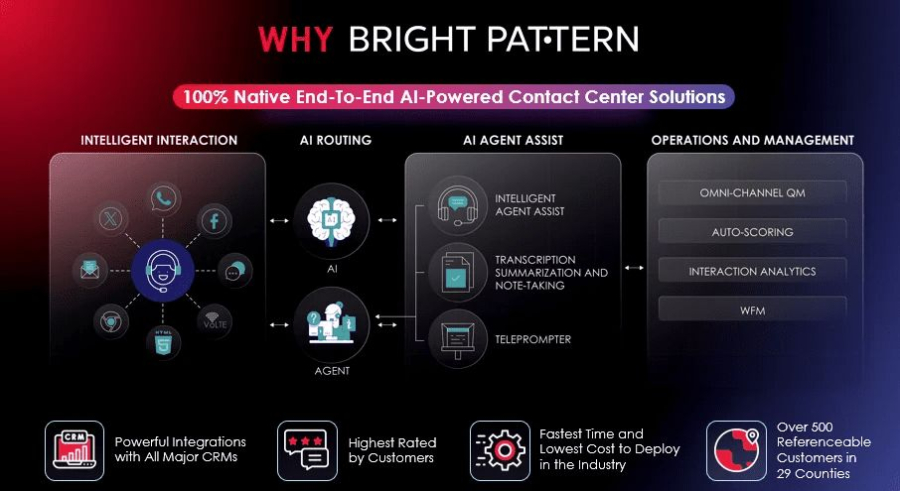
Bright Pattern is trusted by companies in healthcare, finance, retail, and telecommunications for delivering intelligent, automated, and consistent AI contact center services at scale.
2. Genesys Cloud CX Services
Genesys Cloud CX provides AI-powered services including predictive engagement, intelligent routing, and analytics. Enterprises can deliver personalized, proactive support while scaling operations efficiently.
3. NICE CXone Services
NICE CXone offers AI-driven automation, workforce optimization, and real-time coaching. Its services help improve agent performance, reduce handle times, and maintain consistent service quality.
4. Talkdesk AI Services
Talkdesk provides virtual agents, workflow automation, and real-time agent assistance. These AI services allow enterprises to automate repetitive tasks, optimize staffing, and improve response times.
5. Amazon Connect Services
Amazon Connect uses AI services like Amazon Lex and Contact Lens for virtual agent automation, sentiment analysis, and speech transcription, enabling cloud-native enterprise-scale support.
6. Zendesk AI Services
Zendesk automates ticket routing, conversational bots, and knowledge base suggestions to help teams resolve inquiries faster and reduce agent workload.
7. Microsoft Dynamics 365 AI Services
Microsoft Dynamics 365 provides virtual agent support, predictive case routing, and real-time AI insights, helping enterprises deliver efficient and personalized customer experiences.
8. Google Cloud Contact Center AI Services
Google CCAI delivers AI-powered virtual agents, real-time agent assistance, sentiment analysis, and workflow automation to optimize enterprise contact center operations.
9. Salesforce Service Cloud + Einstein AI Services
Salesforce Einstein integrates AI into Service Cloud for intelligent case routing, workflow automation, predictive recommendations, and real-time agent guidance, improving both efficiency and customer satisfaction.
10. Five9 AI Services
Five9 offers virtual agents, smart IVR, and real-time agent assist to automate routine interactions and improve overall contact center productivity.
Key benefits of an AI contact center service
1) Faster response times without sacrificing quality
Customers value speed, but speed alone is not enough. AI helps deliver both speed and accuracy by handling simple questions instantly and accelerating agent workflows for complex cases. For example, virtual agents can deflect repetitive inquiries like order status, password reset steps, store hours, or basic eligibility checks. Meanwhile, agent assist can reduce time spent searching knowledge bases and composing messages from scratch.
In practice, faster time-to-first-response and quicker resolution can show up across channels, especially during peak volume periods when queues would otherwise grow.
2) Better consistency across every agent and channel
Even strong teams struggle with consistency when policies change or when different agents interpret processes differently. An AI contact center service can standardize best practices by:
- Suggesting approved answers aligned with your knowledge base
- Guiding agents through required steps (for example, verification workflows)
- Flagging missing information before a case is closed
- Providing uniform tone and structure in written responses
This is especially valuable for businesses with multiple sites, remote workforces, or seasonal hiring.
3) Higher customer satisfaction through smoother journeys
AI can reduce friction by collecting key details upfront, routing customers correctly, and providing 24/7 coverage for common needs. When customers do need a person, AI can pass context forward so the customer does not have to repeat themselves.
That combination of less repetition, smarter routing, and more relevant answers is often what drives satisfaction improvements over time.
4) Increased agent productivity and lower cognitive load
Contact center work is demanding: agents must listen, empathize, follow policies, and use multiple systems at once. AI helps by reducing manual steps and giving agents a “co-pilot” that supports:
- Real-time knowledge retrieval
- Suggested next actions
- Auto-generated notes and summaries
- Drafted responses that agents can edit and personalize
When agents spend less time on administrative tasks, they can spend more time on meaningful problem-solving and customer relationships.
5) More insight from conversations you already have
Every contact center has a rich dataset of customer conversations. AI can help transform that unstructured data into usable operational insight, such as:
- Emerging issue detection (product bugs, shipment delays, policy confusion)
- Top drivers of repeat contacts
- Intent trends by region, channel, or customer segment
- Quality and compliance checks based on conversation patterns
This is one of the most strategic benefits: AI does not only help you answer faster today, it can help you build a better customer experience tomorrow.
High-impact use cases to prioritize first
To get early wins, focus on repeatable interactions with clear success criteria. Many organizations start with the following:
Customer self-service (chat and voice)
- Order status and delivery updates
- Returns initiation and policy explanations
- Account updates and password reset guidance
- Appointment scheduling and reminders
- FAQ-driven support for products and services
Intelligent routing and triage
- Intent-based routing (billing vs. technical support vs. sales)
- Language-based routing for multilingual support
- Priority routing for VIP customers or urgent cases
- Queue deflection to digital channels when appropriate
Agent assist and knowledge acceleration
- Suggested replies with consistent formatting and tone
- On-screen article recommendations based on what the customer is saying
- Real-time form filling support (capturing key fields from the conversation)
- Auto-summaries and disposition tagging after the interaction
Quality management and compliance support
- Automated interaction categorization for sampling and review
- Detection of missed required disclosures in scripts (where applicable)
- Coaching opportunities based on conversation patterns
What success looks like: outcomes and metrics to track
An AI contact center service is most persuasive when it is measured by customer outcomes and operational performance. Consider tracking a mix of customer, agent, and efficiency metrics.
| Goal | Metric | What AI influences |
|---|---|---|
| Faster service | Time to first response, average speed of answer | Self-service containment, smarter routing, faster agent drafts |
| Better resolution | First contact resolution (FCR), repeat contact rate | Knowledge accuracy, guided workflows, context transfer |
| Higher satisfaction | CSAT, NPS (where used), sentiment trends | Reduced friction, consistent answers, personalization |
| Operational efficiency | Average handle time (AHT), cost per contact | Automation, summarization, reduced after-call work |
| Agent enablement | Agent effort score, ramp time, utilization | Real-time coaching, knowledge surfacing, workflow support |
| Service reliability | Containment rate, fallback rate, escalation quality | Conversation design, intent coverage, integration completeness |
Because AI impacts multiple stages of the journey, improvements are often incremental at first, then accelerate once you optimize the knowledge base, integrate systems of record, and tune conversation flows.
Real-world success patterns (what high-performing teams do)
Results vary by industry and maturity, but high-performing teams often share the same playbook:
They start with a clear definition of “done”
Instead of measuring “AI adoption,” they measure outcomes like successful self-service completion, correct routing, reduced transfers, and improved resolution. They also define guardrails: when to escalate to a person, which actions require verification, and which topics should always be handled by specialists.
They invest in knowledge quality
AI performs best when the source of truth is clean, current, and structured. Teams that treat knowledge management as a product (with owners, review cycles, and feedback loops) tend to see faster improvements in self-service and agent assist accuracy.
They design for escalation, not just deflection
Great AI experiences make it easy to reach an agent when needed, with context preserved. Customers appreciate self-service when it works, but they appreciate seamless escalation even more when it does not.
They empower agents with AI, then coach to excellence
When agents trust AI suggestions, adoption grows. The best teams provide training on how to use drafts responsibly, how to validate responses, and how to personalize tone while staying within policy. They also use analytics to identify coaching opportunities and knowledge gaps.
Capabilities to look for in an AI contact center service
If you are evaluating platforms or managed services, prioritize capabilities that directly support resolution and scalability:
Omnichannel coverage
Look for consistent AI behavior across chat, email, messaging, and voice, with unified context and reporting.
Strong integration options
AI becomes far more valuable when it can take action, not just answer questions. Common integration points include CRM, ticketing, order management, identity and verification tools, billing, and knowledge systems.
Human-in-the-loop controls
For many teams, especially in regulated or high-stakes environments, it is important that AI suggestions are reviewable and that sensitive actions require confirmation. This supports trust, safety, and compliance with internal policies.
Knowledge management and content workflows
Look for easy ways to maintain articles, track what customers ask, and turn gaps into new content. The fastest improvements often come from closing knowledge gaps revealed by conversation analytics.
Analytics that connect to business outcomes
Dashboards should help you tie AI performance to outcomes like containment, resolution, customer satisfaction, and contact drivers. Insight without action is not enough.
Security and privacy fundamentals
Contact center data can include personal and sensitive information. A credible AI contact center service should support strong access controls, data handling practices, and administrative oversight aligned with your organizational requirements.
Implementation roadmap: how to roll out AI without disruption
AI adoption is most successful when it follows a deliberate, phased rollout. Here is a practical roadmap many organizations use.
Phase 1: Identify top contact drivers and quick wins
- Analyze the top 10 to 20 reasons customers contact you
- Select 3 to 5 intents that are high volume and clearly defined
- Decide the target channel first (often chat before voice)
- Set baseline metrics for containment, resolution, and customer satisfaction
Phase 2: Prepare knowledge and workflows
- Audit knowledge articles for accuracy and completeness
- Standardize answers for policy-heavy topics
- Define escalation criteria and handoff data (what context is passed to agents)
- Map required integrations for tasks you want to automate
Phase 3: Pilot with guardrails
- Launch to a subset of traffic or a specific customer segment
- Use fallback flows for out-of-scope questions
- Capture customer feedback and agent feedback continuously
- Review transcripts to identify misunderstanding patterns
Phase 4: Expand and optimize
- Add new intents, languages, and channels
- Improve routing rules based on observed outcomes
- Increase automation for verified, low-risk tasks
- Use analytics to reduce repeat contacts and remove friction points
Phase 5: Operationalize continuous improvement
- Create ownership for AI performance (operations, knowledge, IT, and QA)
- Schedule regular reviews of top failures, top escalations, and new topics
- Align AI updates with product launches and policy changes
- Maintain documentation for workflows and approvals
Example conversation design: a simple, effective flow
A strong AI experience often follows a straightforward structure: confirm the need, collect minimum details, attempt resolution, then escalate gracefully if needed.
1) Greet and set expectations “I can help with order status, returns, and account questions.” 2) Identify intent “What can I help you with today?” 3) Collect key fields “Please share your order number or the email used at checkout.” 4) Provide resolution or next best action “Your package is estimated to arrive on Tuesday.” 5) Offer additional help “Would you like delivery instructions or to start a return?” 6) Escalate with context if needed “I’m going to connect you with a specialist and share what we’ve covered.”
This structure keeps interactions short, clear, and outcome-driven, while still providing a smooth path to a human when the request is nuanced.
Where AI delivers the most value: common scenarios by industry
AI contact center services can support many industries, but the highest impact often appears where there is high volume, repeatable requests, and strong data signals.
Ecommerce and retail
- Order status, shipping updates, returns, exchanges
- Product availability questions and store information
- Promotion and policy clarifications
SaaS and technology support
- Account access and billing questions
- Guided troubleshooting and how-to support
- Routing to specialized technical teams
Financial services and insurance
- General policy and coverage education
- Status updates (claims, applications) where appropriate
- Appointment or callback scheduling
Healthcare administration (non-clinical)
- Scheduling, reminders, and administrative FAQs
- Directions, hours, and paperwork guidance
- Routing to the appropriate administrative department
In regulated environments, AI is often used first for administrative support and agent assist, with careful governance for any automated actions.
How to make your AI contact center service feel human (without pretending it is)
Customers do not require a bot to sound like a person. They want it to be helpful, transparent, and fast. The most effective experiences usually include:
- Clear disclosure that the customer is interacting with an automated assistant
- Concise prompts that avoid long menus and jargon
- Smart clarifying questions only when needed
- Context retention so customers do not repeat details
- Respectful escalation when the request is complex
When your AI consistently solves real problems quickly, customers perceive it as “human-friendly,” even if it is clearly automated.
Choosing the right approach: platform, managed service, or hybrid
There is no single best model for every organization. Many teams choose one of three approaches:
AI-enabled contact center platform
Best for teams with in-house operations, analytics, and IT capacity. You get more direct control over configuration and optimization.
Managed AI contact center service
Best for teams that want faster time-to-value and ongoing expertise. A provider can help design flows, manage knowledge, tune models, and monitor performance.
Hybrid model
Common in practice: internal teams own strategy and customer experience, while a partner supports implementation, analytics, and continuous improvements.
Whichever model you choose, the strongest results typically come from clear ownership, measurable goals, and a steady cadence of iteration.
Getting started: a practical checklist
- Define outcomes: what does success mean for customers, agents, and operations?
- Pick initial intents: start with high-volume, well-defined requests.
- Prepare knowledge: ensure content is accurate, current, and easy to retrieve.
- Plan integrations: decide where AI should read data and where it should take action.
- Design escalation: ensure customers can reach an agent quickly with context preserved.
- Set governance: approvals, monitoring, and change management for AI flows.
- Measure and iterate: use transcript reviews and analytics to improve weekly.
Why now is the right time to adopt an AI contact center service
Customer expectations for speed and convenience continue to rise, while support teams face pressure to do more with the same resources. An AI contact center service offers a practical path forward: faster resolutions, more consistent service, more empowered agents, and deeper insight into customer needs.
The most compelling advantage is compounding value. Each new intent you add, each knowledge gap you close, and each workflow you automate makes the next improvement easier. Over time, AI becomes not just a feature in your contact center, but a scalable engine for customer experience excellence.
